
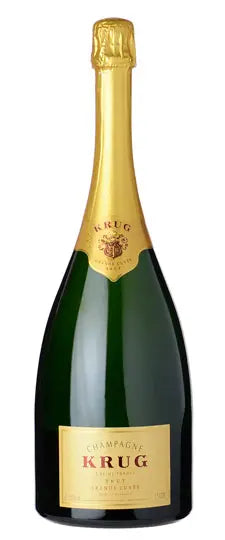
Krug Grand Cuvee 1.5L
Couldn't load pickup availability
Krug Grand Cuvee 1.5L
*Availability may vary. Images are for reference only. Design may vary.
Description
Description
Krug Grand Cuvée 1.5L is a prestige non-vintage Champagne from Krug in magnum format, bottled at 12% ABV. Awarded up to 97 points by James Suckling and Tyson Stelzer for Decanter, the Grand Cuvée stands as one of Champagne's most consistently acclaimed multi-vintage blends — and the magnum format allows its complex flavors to evolve with even greater harmony during extended aging on the lees.
Quick Facts: ABV: 12% | Origin: Champagne, France | Multi-Vintage (NAS) | House: Krug | Format: 1.5L Magnum
Production & Heritage
Founded in 1843 by Joseph Krug and now part of the LVMH portfolio, Krug remains the only major Champagne house to ferment every base wine in small 205-litre oak casks — some dating back to 1964, with an average barrel age of 25 years. This oak fermentation exposes the wines to micro-amounts of oxygen during the first fermentation, building intensity and resilience against oxidation over time. Each edition of the Grand Cuvée blends roughly 120 wines from more than ten different vintages, with a typical composition of approximately 45% Pinot Noir, 35–39% Chardonnay, and 16–22% Pinot Meunier, followed by a minimum of six years of lees aging in Krug's cellars beneath Reims. The magnum format slows secondary fermentation and maturation, producing a finer mousse and deeper integration of flavors compared to the standard 750ml bottle.
Tasting Notes
Aroma: The nose opens with toasted hazelnut and praline before unfolding into layers of nougat, honey, and warm gingerbread. A fresh undercurrent of lemon zest, grapefruit pith, and ripe peach lifts the richness, while floral notes add further dimension.
Taste: The entry is generous and fleshy, with barley sugar, marzipan, and brioche flooding the mid-palate. Citrus and jellied fruits provide structure and acidity, keeping the wine focused and precise. The overall impression is one of seamless complexity — each sip reveals new layers without ever feeling heavy.
Finish: Long and poised, with lingering notes of toasted almond, honeycomb, and a fine saline minerality. The mousse remains creamy through the very end, leaving a signature sense of completeness that lingers well after the final sip.
How to Drink Grand Cuvée
Serve at 48–52°F in a generous white wine glass rather than a narrow flute — the wider bowl releases the full aromatic spectrum built during years of lees contact. Grand Cuvée is at its best sipped on its own, though a magnum poured generously rewards exploration across an entire evening. For cocktail applications: a Champagne Cocktail (sugar cube, Angostura, lemon twist) highlights its toasty richness; a French 75 gains remarkable depth from the wine's oak-driven body; and a simple Kir Royale with high-quality crème de cassis pairs beautifully with the underlying fruit intensity.
Best For
- Anchoring a celebration dinner for six to eight guests — the magnum format pours generously across multiple courses
- Gifting a serious Champagne collector who values the slower maturation curve of large format bottles
- Toasting milestone anniversaries, retirements, or once-in-a-lifetime achievements
- Building a cellar of prestige Champagne — magnums age more gracefully and hold long-term value
Frequently Asked Questions
What does Grand Cuvée taste like? Krug Grand Cuvée delivers a rich, layered profile dominated by toasted hazelnut, brioche, nougat, and honey, balanced by bright citrus and stone-fruit acidity. The texture is creamy and full-bodied, distinguishing it from lighter non-vintage Champagnes.
How does Grand Cuvée compare to Dom Pérignon? Krug Grand Cuvée is known for its richer, fuller body, driven by oak fermentation and extended multi-vintage blending, while Dom Pérignon tends toward a more refined and linear elegance built from a single vintage. Both are prestige-level Champagnes, but Krug appeals to those who favor depth and complexity, whereas Dom Pérignon emphasizes precision and purity.
Is Grand Cuvée good for sipping neat? Absolutely — Grand Cuvée is designed as a contemplative Champagne best appreciated on its own or alongside food, where its complexity and texture can be fully explored. Its minimum six years of lees aging produce a wine that rewards slow, attentive drinking.
Where is Grand Cuvée made? Krug Grand Cuvée is produced by Maison Krug in Reims, in the heart of the Champagne appellation in northeastern France. The house sources grapes from plots across the Champagne region, including top villages in the Montagne de Reims, Côte des Blancs, and Vallée de la Marne.
What foods pair well with Grand Cuvée? Seared scallops with brown butter complement its toasty richness; aged Comté or Gruyère echoes its nutty depth; roast chicken with herb jus matches its weight without overwhelming its finesse; smoked salmon plays off its citrus backbone; and tarte Tatin mirrors its caramelized fruit and pastry notes.
What sizes does Grand Cuvée come in? Krug Grand Cuvée is available in 375ml half-bottles, standard 750ml bottles, and the 1.5L magnum format featured here, which is prized for its superior aging potential and finer effervescence.
Is Grand Cuvée worth the price? Krug Grand Cuvée positions firmly in the ultra-premium tier alongside Dom Pérignon and Louis Roederer Cristal, and its unique oak fermentation, multi-vintage blending of over 120 wines, and minimum six-year aging justify its standing. The magnum format adds further value for collectors and serious drinkers, as large-format Champagne ages more gracefully and commands respect at the table.
Why Grand Cuvée?
No other major Champagne house ferments every base wine in small oak casks — a practice Krug has maintained since its founding in 1843. This singular approach, combined with the blending of wines from more than ten vintages, produces a non-vintage Champagne of a complexity that rivals many vintage-dated prestige cuvées. Critics have consistently validated this distinction, with scores reaching 97 points from both James Suckling and Tyson Stelzer for Decanter. In the 1.5L magnum, that complexity is further refined by slower, more even maturation — making this among the most compelling large-format Champagnes available in the prestige category.
Specifications
Specifications
-
Varietal/Type
-
Product of
-
Region
-
Size
-
Brand
Payment & Security
Payment methods
Your payment information is processed securely. We do not store credit card details nor have access to your credit card information.
New Arrivals
-
 New arrival
 -
-

-


Cutwater
Cutwater Gingerbread White Russian 4PK
In stock4PK 12OZ Cans$12.99Unit price /Unavailable -

-

-


-

 Sold out


